
Designing Videos with Intention: Reflections from OLC Innovate
In early March, I had the opportunity to attend OLC Innovate, a virtual conference centered on innovative ideas and best practices for online and digital learning. One session that particularly resonated with me was “Lights, Camera, Learn! Transforming Online Education Through Strategic Video Design” (Cisneros et al., 2026), a multimedia-focused presentation led by a team from Angelo State University and the American College of Education.
As multimedia is increasingly expected in online courses, this session offered a thoughtful mix of theory, tools, and practical guidance for incorporating videos more effectively into learning. Grounded in Mayer’s Cognitive Theory of Multimedia Learning (2021), the presenters connected theory to practice by outlining video design strategies for managing cognitive load, such as chunking topics, simplifying visuals, and connecting content to engagement.
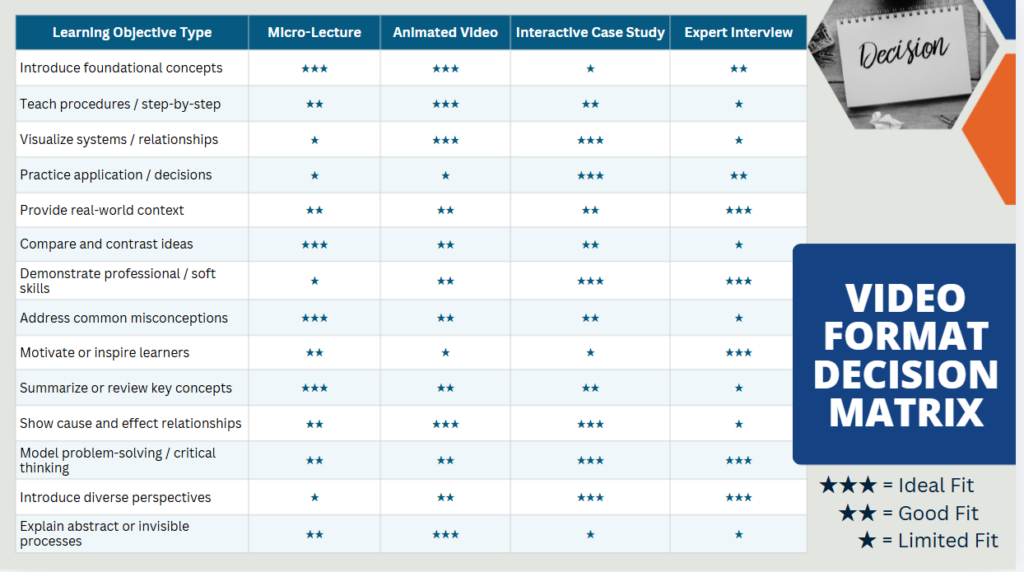
One of the most useful takeaways was the value of matching video types to specific learning objectives or teaching strategies. For example: using quick micro‑lectures to introduce concepts, short animations to visualize complex ideas, and longer interactive videos, such as case studies, that pause to prompt reflection or application. While a video’s length doesn’t always correspond to cognitive load, I find myself mentally mapping these formats along a continuum, similar to Bloom’s Taxonomy, with increasing levels of engagement and cognitive complexity as learners move from introduction to application. To support intentional choices, the presenters shared their own decision matrix, illustrating how well different video formats may fit specific activities or objectives (right image, slide 15). They also noted how they will combine styles and vary formats throughout a course to support and sustain student engagement.
Reflecting on my own online teaching practice, I realize that while I regularly incorporate a variety of video formats and place them thoughtfully within the course, I have often done so more intuitively than deliberately. I have also frequently relied on existing videos, whose formats or styles don’t always align as closely with the instructional purpose as I might prefer. This session prompted me to think more intentionally about aligning video type with specific concepts and related learning activities, and it also renewed my motivation to create my own videos when available options aren’t the right fit.
Ultimately, the session reinforced a simple but important shift: effective video use in online learning isn’t about presence, placement, or conciseness alone, but about intentional design and integration. As with any decision in course design, this means approaching video design as an iterative process: starting small, building confidence, and refining over time to support both sustainability and continuous improvement.
Now, the questions at the top of my online course revision list are: What course concept can be better supported or clarified through a more intentionally designed video? What video format or style best fits that?
Have you experimented with different video formats in your online course? If so, which approaches have resonated most with your students and at what points of learning?
References & Resources
Bairstow, N. (2023, November 21). Animating education: A teaching tool that brings learning to life. Times Higher Education.
Center for the Advancement of Teaching Excellence. (2023). Micro‑lecture videos. University of Illinois Chicago.
Cisneros, A., Huck, C., Speer, M., & Corder, K. (2026, March 4). Lights, camera, learn! Transforming online education through strategic video design [Conference presentation slides]. OLC Innovate Conference (virtual).
Digital Learning Institute. (n.d.). How to use Mayer’s 12 principles of multimedia learning.
Mayer, R. (2021). Multimedia Learning (3rd ed.). Cambridge University Press.