
We Don’t Need No Stinkin’ Badges! Or Do We?
|
About this post This post grew out of two conversations about digital badges and microcredentials in 2025. On May 2, I participated in City Tech’s inaugural Microcredentials Forum at the New York City College of Technology, CUNY. The event was coordinated by Benito Mendoza, Ph.D., Associate Professor in the Department of Computer Engineering Technology, and Jose Diaz, M.Ed., Director of Academic Technologies and Online Learning (AtoL). I participated in the panel discussion with Michael Oldani, Shayla Pruitt, and Sean Carey, moderated by Jose Diaz. A few months later, my conversation with Adam Davi, M.A., M.S., Instructional Design Manager with UCATT at the University of Arizona, was published as part of the Futures in Digital Learning podcast. These two conversations gave me an opportunity to reflect on what more than a decade of building the SUNY Online Teaching badging ecosystem has taught me.
Beyond the Certificate: How Digital Badges Make Community, Contribution, and Expertise Visible |
My friend and colleague Professor Bill Pelz has a running response whenever I start talking enthusiastically about digital badges: “We don’t need no stinkin’ badges!” He says it to tease me, because he knows how passionate I am about them, but there is a useful challenge embedded in the joke. If a digital badge is nothing more than a prettier certificate or a virtual sticker, why do we need it?
After more than a decade of developing the SUNY Online Teaching badging ecosystem, I’ve come to believe that digital badges become much more interesting when we stop thinking of them only as smaller versions of certificates.
Yes, badges can recognize learning and verify competencies. But they can also recognize roles, contributions, service, expertise, leadership, participation, and professional identity. They can help us understand who is who in a community, what that community values, and how people might participate, contribute, and grow within it.
I think we tend to start too small when we talk about digital badges. We start with credentials. We ask how a badge differs from a certificate, what learning someone completed, or what competency it verifies. Those are important uses for badges. I use them that way, too.
But I think the more interesting question is: What else can a badge make possible?
So… What Is a Digital Badge, Really?
At first glance, a digital badge might look like a simple icon. But behind that visual there is powerful metadata. A well-designed badge can tell you what someone did to earn it, the skills or competencies demonstrated, the criteria that were met, the evidence submitted, who issued the badge, when it was awarded, and, when appropriate, whether it expires or requires renewal.
Compare that with a traditional certificate. Even a beautifully embossed certificate may tell you little more than Alejandra completed a training on online teaching in June 2025. You don’t necessarily know what was involved, how rigorous it was, what I was asked to demonstrate as a result of the training, whether or how well I did that, or what the accomplishment means in practice.
And while a diploma may end up in a fancy frame on the wall behind your desk, certificates have a tendency to disappear into folders, desk drawers, or a line on a CV.
A digital badge can travel. I can put it on LinkedIn, add it to a professional profile or digital portfolio, include it in my email signature, or share it with colleagues and employers. Someone who encounters it can explore what stands behind it.
Here’s where I think the conversation gets more interesting.
The thing represented by the badge doesn’t have to be a course or a competency. A badge can represent expertise, professional standing, a role in a community, service, leadership, participation, types of engagement, contribution, or an accomplishment. A digital badge does not have to be a mini certificate.
My Badging Origin Story

I earned my first digital badge from EDUCAUSE in 2014, and yes, it is still there and is one of my most prized possessions! – I was thrilled to earn it because it was from EDUCAUSE, for a presentation I did, and because I could share it on my LinkedIn profile and on my CV. I didn’t think much more about badging though until later that year when I attended a conference where I learned more about Credly and digital badge-issuing platforms, and I remembered how cool it was to get that first badge.
The timing was perfect. We were reimagining the SUNY Learning Network, and the Open SUNY Center for Online Teaching Excellence was being created. As part of that work, we had developed Open SUNY Online Teaching Fellow roles, now SUNY Online Teaching Fellows, to codify membership in our growing community of online practitioners.
I wanted a framework that could support communication, connection, networking, interaction, and collaboration across our community of practice. We certainly wanted to recognize professional development and competencies. But I also wanted members to know who was who in the community. Who were our mentors? Who had particular expertise? Who was willing to review online courses? Who was sharing effective practices? Who was contributing, leading, volunteering, or helping others?
I wanted to recognize those roles and contributions, encourage behaviors that strengthened the community, commemorate participation, honor exemplary practices, validate expertise, recognize people who shared what they knew, and identify those qualified to take on particular responsibilities.
That was the beginning of the SUNY Online Teaching badging ecosystem.
Ecosystem Design
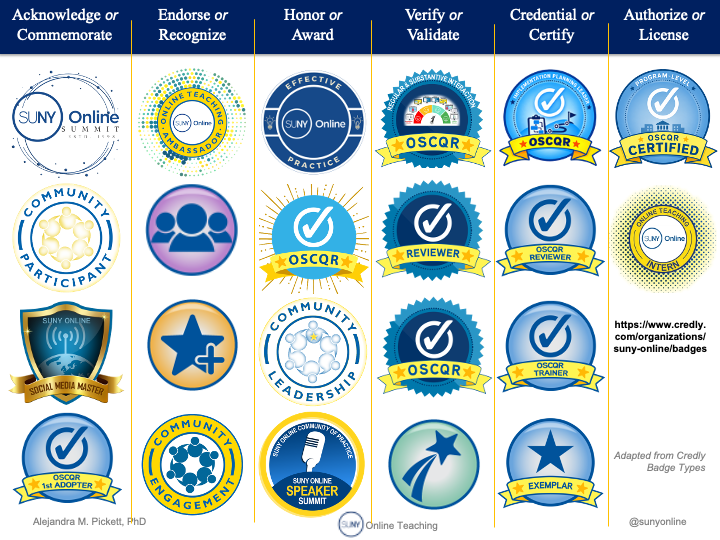
Explore SUNY Online Teaching badges and certifications.
View the graphic full size.
Over time, our badges have come to serve six broad purposes. We use them to acknowledge or commemorate participation and milestones; endorse or recognize membership, engagement, service, and contribution; honor or award excellence, innovation, and impact; verify or validate experience and expertise; credential or certify professional learning and demonstrated competency; and authorize or license people to perform particular roles or activities.
Communities of practice run on much more than formal learning. They run on people sharing what they know. Mentoring one another. Volunteering. Reviewing. Leading. Trying something innovative and telling others what happened. Showing up. Contributing. Taking responsibility for some part of the work of the community.
Badges give us a way to recognize those things, too.
Who Is Who?
This may be my favorite aspect of the ecosystem.
Our Fellows, Online Teaching Ambassadors, mentors, OSCQR reviewers and trainers, award recipients, effective-practice contributors, speakers, volunteers, and other recognitions help people see who is who in our community. They identify people with particular expertise or experience, people contributing in particular ways, and people who might be resources for others.
I originally thought about Online Teaching Fellows as individuals existing along a continuum from novice to master, within a matrix of opportunities to both give to and get from the community. As the ecosystem has developed, I have come to see it more as a constellation of interconnected pathways. There isn’t one ladder everyone needs to climb. Someone might become a mentor. Someone else might become an OSCQR reviewer or trainer. Another person might share an innovative effective practice or their research, become an ambassador, develop deep expertise in online course design, or take on a leadership role.

An important part of that community has also been keeping it open beyond SUNY. While the ecosystem grew out of our work across the SUNY system, many of our professional development opportunities, communities, resources, and badging pathways engage practitioners from other institutions and organizations as well. That openness brings perspectives, experiences, and practices into the community that we would not encounter if we only talked to ourselves. It broadens the network of people we can learn from, collaborate with, and turn to for ideas, while giving SUNY practitioners opportunities to contribute their own expertise to a wider professional community.These are different ways of growing and contributing. They enrich the community in different ways. Anyone is welcome to become a Friend of SUNY!
“A badge can help someone say, This is where I am. Looking across the community can help them imagine where they might go next.”
A badge can help someone say, This is where I am. Looking across the community can help that same person think, That’s someone I could learn from. That’s something I’d like to do. That’s a person I could ask for help. Maybe that’s where I’d like to go next. And perhaps just as importantly: That’s a way I could contribute.
For me, that is where badging becomes something more than recognition. It can model roles and identities and support belonging, connection, inspiration, aspiration, and shared responsibility for the community itself.
That visibility matters beyond the community, too. One application I care deeply about has been using badges to help professionalize the role of the online instructional designer at SUNY.
Instructional designers do enormously important work, but their expertise has not always been readily visible or consistently understood. Having a reputable organization validate an individual’s expertise, experience, or contribution provides a portable endorsement. It can build professional credibility and trust and become part of a professional profile, performance or promotion process, résumé, or future job search. The same is true for people whose contributions may never result in a traditional credential: interns, mentors, volunteer course reviewers, ambassadors, speakers, effective-practice contributors, and others.
A badge gives individuals and their organizations a mechanism for formally recognizing professional preparation, standing, and contribution. It says: We see this. We value it. We recognize what you contributed, and we are willing to put our name behind that recognition.
That’s very different from saying someone attended a workshop.
Not All Badges Are Created Equal
At the City Tech forum, we talked about what makes a badge meaningful rather than merely decorative. My answer is pretty straightforward: A badge is only as meaningful as the issuer and the evidence or criteria behind it.
I have some badges that are essentially commemorative. They’re beautiful, they recognize participation in a special event, and that’s exactly what they’re intended to do. Other badges represent much more substantial accomplishments.
Someone who attends an OSCQR workshop, for example, can receive a participation badge showing that they received an orientation to OSCQR and its tools, resources, and course-review process.
However, formal OSCQR certification as an online course reviewer or trainer is a very different matter. Participants have to apply what they learned in the workshop to an actual online course review, submit their completed rubric with notes, recommendations, and priorities, and write a reflection addressing criteria I provide. We review the work and provide feedback. Sometimes people have to revise and resubmit before certification is awarded.
Each badge in the certification pathway functions independently, but together they can document the full arc of an online course review and refresh process, from learning how to use OSCQR to applying it in practice. That is one of the things that differentiates OSCQR certification from other professional certifications. To become a certified OSCQR online course reviewer, you don’t just demonstrate that you can fill out a rubric. You conduct an actual review, work with the instructor to identify and prioritize improvements, and participate in improving the course based on that review.
The important question is whether the criteria and evidence behind the badge support the claim the badge is making.

The issuer matters, too. Partnerships, collaborations, and external recognition have strengthened our ecosystem over time. Our partnership with OLC around OSCQR, recognitions from WCET, collaborations with SUNY COIL, and the visibility OSCQR has gained in broader higher education quality and accreditation contexts have helped extend recognition beyond SUNY. Campus partnerships have allowed us to apply the framework in different settings and for different purposes.
All of that contributes to the credibility behind a badge. And yes, I want the badges themselves to be beautiful. They are meant to be seen and shared. But visual appeal is not what gives them credibility. If people don’t recognize or trust the issuer, or understand what the badge actually represents, a beautiful badge is still just a graphic. Trust is what gives the recognition meaning.
Telling a Professional Story
Badges can change the way we think about professional development, too. Instead of I took a workshop, got my certificate, and I’m done, a collection of badges can develop over time into a much richer professional story. That story might include learning, service, leadership, expertise, mentoring, volunteering, innovation, community roles, awards, and impact.
Badges also work well for just-in-time learning. Not every emerging need requires a semester-long course or another degree. Sometimes I need to learn something relevant to the work I’m doing right now, and meaningful recognition of that learning has value.

I’ll admit it: I LOVE earning badges. I recieved a badge for participating on the panel for City Tech. I’d like a badge for writing this post! I’d love a badge from Adam for doing his podcast!!
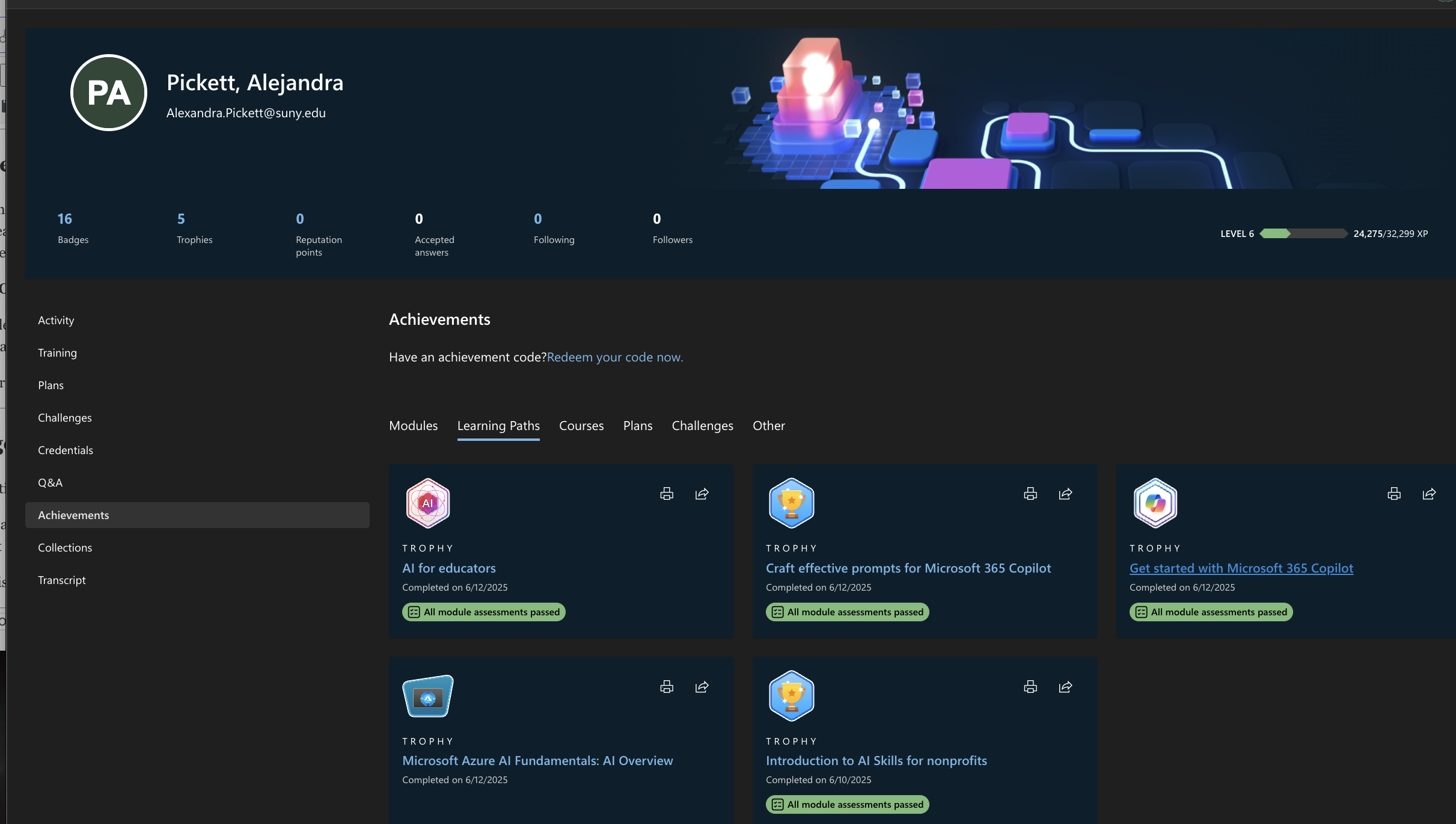
I recently completed a series of AI learning experiences after seeing a friend share a Microsoft badge on LinkedIn. I noticed it. The topic was highly relevant to my work. Microsoft was a credible issuer. And I thought, I want one of those.
I investigated, started learning, and ultimately earned five Microsoft trophies through their badged learning paths. Someone else’s recognition introduced me to a learning opportunity I didn’t know about. That’s a small example of something badges can do remarkably well. They can prompt curiosity and motivate action.
One of the questions Adam asked me was what motivates people more: the badge itself or the skills they’re developing.
For me, the answer is both.
For some of us, and I clearly include myself here, the badge can be part of the initial attraction. It’s tangible. It’s visual. I can share it. It represents something I accomplished. But a pretty badge won’t sustain engagement if what stands behind it has no value. The recognition becomes meaningful when the experience, accomplishment, contribution, or learning means something to the person earning it.
The sweet spot is pretty simple: I value what I did, and I value having it recognized.
Gamification?
Yes, badges can introduce elements of gamification. There can be a little dopamine spark when you earn the next badge, complete a pathway, or see something another person earned and decide you want to pursue it, too. My Microsoft experience is a perfect example.
But a thoughtfully designed badging ecosystem can do much more than create competition or a leaderboard. It can incentivize and recognize behaviors and provide a framework of activities and opportunities that support a vibrant, diverse community of online practitioners. That’s what interests me much more.
A mentor badge tells people that mentoring matters. It also identifies someone willing and able to mentor. An effective-practice badge showcases a vetted approach and says that sharing what works matters. An ambassador badge says outreach and enthusiasm matter. A reviewer badge recognizes expertise and identifies someone who can contribute to the continuous improvement of online course design and quality.
Badges don’t simply reward behaviors after they happen. They can signal what a community values and encourage more of it.
Not Just Recognition
This is another use of badging that I think deserves more attention.
We’ve worked with campuses to develop cohorts of peer online course reviewers using OSCQR. On a campus with limited instructional design resources, preparing and recognizing qualified peer reviewers extends the capacity of a small distance-learning or instructional-design team. More people become capable of participating meaningfully in online course quality improvement.
We’ve also worked with schools of education where graduate learners in instructional design programs can earn OSCQR certification as part of their degree experience. Centers for teaching and learning and online-learning departments have used certification to develop expertise among the people supporting online faculty. We are also working with institutions to recognize larger-scale online course quality initiatives to certify implementation planning leaders, and institution-wide efforts.
So badging can do more than recognize capacity after it exists. It can help create that capacity in the first place.
But that kind of capacity doesn’t come from simply creating more badges. It depends on designing an ecosystem in which the badges have clear purposes, relationships, pathways, and requirements.
Build an Ecosystem, Not a Badge Collection
“Don’t start by asking, What badges could we create? Start by asking what you are trying to make visible, encourage, recognize, validate, or build.”
I’ve learned that it is very easy to create more badges. It is much harder to build and sustain an ecosystem.
I maintain a spreadsheet that helps me see how our badge collections fit together: what each badge represents, what is required, whether there are prerequisites, how badges might connect or stack, and what opportunities could come next. You can see some of that framework in my SUNY Online Teaching Badging Ecosystem presentation.
The original program was developed collaboratively with colleagues across SUNY, and that involvement mattered. Transparency, broad representation, and input helped people understand what we were doing and why. Providing opportunities for people to shape the framework is important if you want genuine buy-in.
There is a practical side to this work that shouldn’t be underestimated. Unsustainable development goals are a real risk. Developing criteria, documenting processes, designing badges, reviewing evidence and nominations, issuing credentials, communicating opportunities, tracking activity, and maintaining an expanding ecosystem all take time.
So I wouldn’t start a badging initiative by asking: What badges could we create? I’d start here: What are we trying to make visible, encourage, recognize, validate, or build within this community?
How Do We Measure Impact?
The SUNY Online Teaching ecosystem has grown to more than 100 distinct badges spanning professional development and community engagement, with more than 14,903 credentials issued through Credly.
Scale is interesting. What people do with the badges is even more important.
We track whether badges are accepted and shared. We see them on LinkedIn, in professional profiles and email signatures, in campus press releases and newsletters, and in materials used for promotion and tenure. Campuses celebrate people who earn them. People ask us for badges.
We’ve also seen job descriptions within SUNY and outside the system mention OSCQR familiarity or certification. To me, that’s particularly meaningful. It suggests that at least some of these recognitions have acquired value beyond the program that issued them.
When someone shares a badge, something else happens. The individual receives recognition, but they’re also telling other people about the activity, program, community, or organization behind it.
My Microsoft badges did exactly that to me. Someone else’s achievement introduced me to an opportunity I hadn’t known about.
Recognition travels.
Why Haven’t Digital Badges Caught On?
I think one of the biggest barriers is still understanding. If people hear “digital badge” and picture a sticker or a gamified reward, they’re going to miss what the metadata, criteria, evidence, and issuer can represent. We need to be much clearer about what badges represent and how they should be used.
Consistency is part of that challenge. Anyone can create a badge, and quality varies. Transparency matters. Who issued it? What does it represent? What did the person actually do to earn it? Can you view the evidence required? Was that evidence reviewed?
Integration can be difficult, too. If badges remain disconnected from HR processes, professional development, promotion and tenure, professional profiles, learning systems, or other places where accomplishments matter, they can still be dismissed as “fluff.”
And then there is culture. Higher education knows what to do with degrees and certificates. We’re still learning how to think about portable digital credentials and recognition of competency, accomplishment, skills, roles, service, contribution, expertise, leadership, and professional identity.
The Future
AI and other technologies will undoubtedly change digital credentials. We may see more sophisticated ways of assessing demonstrated skills, recommending individualized learning pathways, and moving verified credentials across systems. Simulations and immersive environments may give people entirely new ways to demonstrate what they know and can do.
But I think the bigger opportunity is conceptual. We need to stop treating the digital badge primarily as a smaller, shinier version of a certificate.
A badge can recognize what someone learned. It can tell me that someone is a mentor, reviewer, ambassador, leader, volunteer, exemplar, innovator, trainer, or contributor. It can recognize someone for sharing an effective practice. It can signal expertise and help me find a person who has it. It can commemorate participation, encourage engagement, validate an accomplishment, authorize someone to take on a responsibility, or show another community member a possible path forward.
A collection of meaningful badges can tell a professional story about an individual. An intentionally designed ecosystem can do something else.
It can tell us about the community.
Who participates? Who contributes? What expertise exists? What does this community value? How can I get involved? Who can help me? How might I grow? Where could I contribute? Those are very different questions from What certificate did you earn?
Perhaps the future of digital badging isn’t primarily about issuing more credentials. Perhaps it’s about becoming much more imaginative about what we choose to recognize, value, and make visible.
Let’s Talk
After more than a decade of doing this work, I still think there are uses for digital badges that we haven’t imagined yet.
Yes, they can recognize learning. But they can also help us recognize the people who make a professional community work: the people who mentor, share, review, lead, volunteer, innovate, contribute, and help others grow. They can help us find one another. They can help someone understand where they are, see possibilities for where they might go next, and recognize ways they can contribute along the way.
That’s a much bigger idea than a digital certificate.
And maybe that is my answer to Bill. If badges are just digital stickers or prettier certificates, maybe we really don’t need them. But I don’t think they are… because if they can help us recognize, connect, and make visible the people, contributions, expertise, and relationships that sustain our professional communities, then I think we have only begun to explore what they can do.
So, what do you think?
How do you use badges in your own institution, organization, or professional community?
What roles, contributions, expertise, or behaviors in your community are important but not always visible?
And what might be possible if we stopped asking only what we could credential with a digital badge and started asking what else we could recognize, value, and make visible?